
North East Museums bidding to save rare flag from battle of Trafalgar for the Nation
17th March 2026
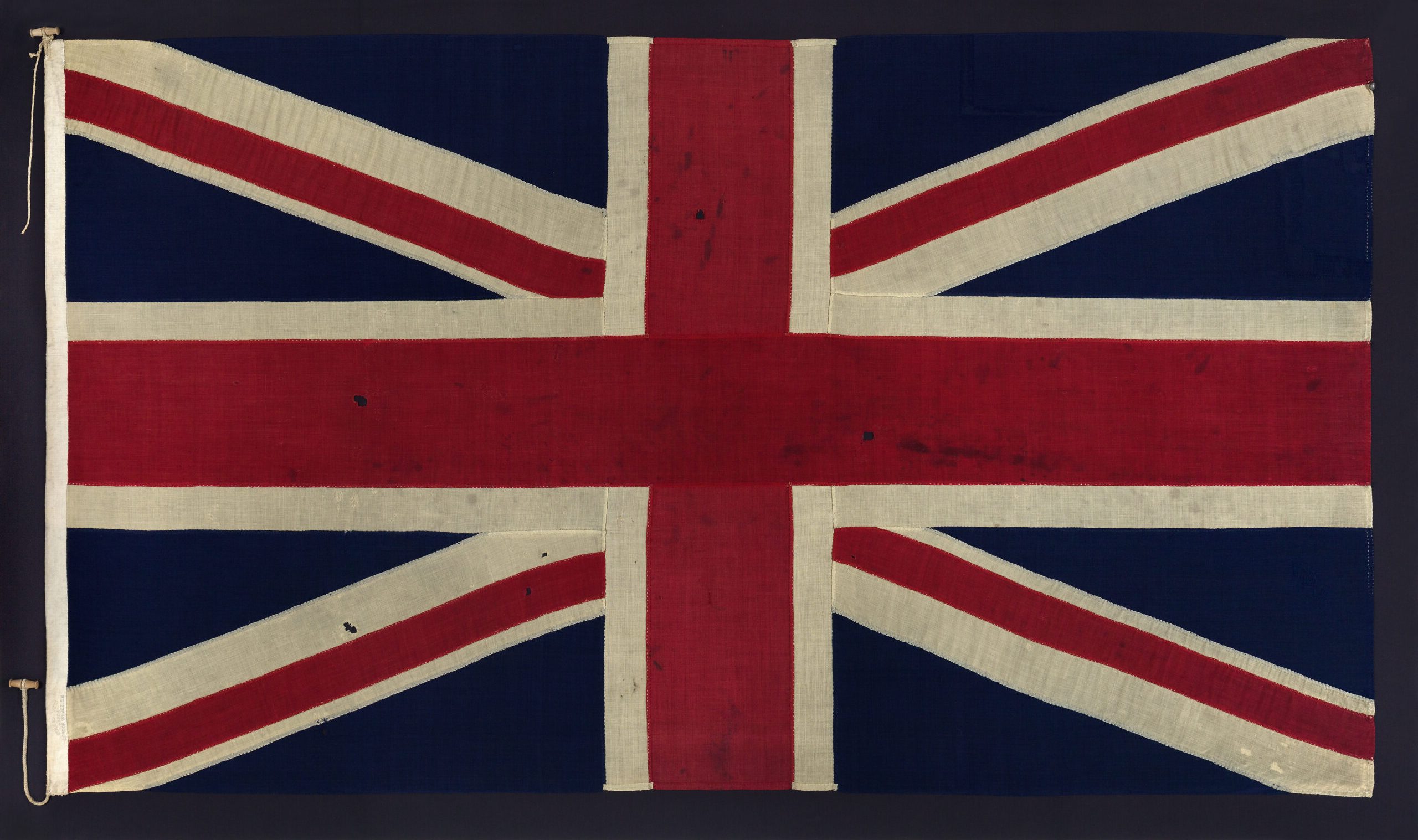
North East Museums is submitting a serious expression of interest to acquire a rare Union Flag that was flown from the HMS Royal Sovereign, flagship of Vice-Admiral Cuthbert Collingwood at the Battle of Trafalgar on 21 October 1805.
An export bar has been placed on the Union Flag by the Secretary of State because of its significance to the nation following a recommendation from the Reviewing Committee on the Export of Works of Art. This process gives a final opportunity for institutions and individuals in the UK the chance to raise the money, purchase the item and retain it in the UK for the public to enjoy. The deadline for serious expressions of interest to purchase the object was 16 March 2026.
The large flag measures 1525 x 2745 mm and is hand-stitched in wool bunting with a weighted edge. It is in good condition, but evidence of scars from the battle can be seen with gunpowder stains and splinter tears. The purchase price has been set at £450,000. If the expression of interest is successful, North East Museums’ acquisition of the flag will be funded by a donation secured from a charitable foundation.
The flag is of particular interest to North East Museums because Vice-Admiral Cuthbert Collingwood, Nelson’s second-in-command at Trafalgar, was from North East England, born in Newcastle upon Tyne on 17 September 1748.
Collingwood recruited many of his sailors from the local maritime community. This led to the Royal Sovereign’s crew gaining the nickname ‘Tars of the Tyne’. The flag itself would have been maintained (and possibly even made) on board the ship by these sailors. Nowhere supplied more men for Nelson’s Royal Navy than the skilled mariners of the Tyne and the Wear, and there were over 500 ‘Geordie’ sailors in Nelson’s fleet at the Battle of Trafalgar.
Keith Merrin, Director of North East Museums, said:
“We hope to secure this rare and historically significant flag to ensure it remains in the UK and to display it in Newcastle upon Tyne as it is not only an important artefact in British history but it has notable connections with North East England. We would like to make Discovery Museum in Newcastle upon Tyne, its permanent home, where it would become a star exhibit enjoyed by hundreds of thousands of visitors each year.”
North East Mayor Kim McGuinness, said: “Admiral Collingwood has a unique place in our maritime and military history – in fact, it is not too much to say he has a place in the hearts of quite a few North East people.
“The statue of Collingwood towering over the mouth of the Tyne is one of our best-loved local landmarks, so it is exciting to think that the union flag that flew from the Royal Sovereign at Trafalgar may soon be coming home to the North East where it belongs.”Tom Holland, Author and presenter of The Rest is History podcast, said: “Second only to his great friend Horatio Nelson, Cuthbert Collingwood is the best loved figure in Britain’s maritime history. It is in his native Northumbria, however, that his memory is especially cherished. Monuments to this heroic man are to be found across the North East: the oaks which he himself planted above what today is St Cuthbert’s Way, the profoundly moving memorial to him in St Nicholas’s cathedral, his colossal statue at Tynemouth. What more fitting home for the flag he flew so boldly at Trafalgar, then, than Newcastle – a city which remains so rightly proud of her famous son?”
Collingwood is a significant figure in the history of North East England and monuments to him can be found throughout Newcastle upon Tyne.
At his birthplace on ‘The Side’, the medieval street by Newcastle Castle, there is a bust of Collingwood on the wall of Milburn House above a plaque that reads ‘Cuthbert Collingwood Victor of Trafalgar, diplomat, wit & humanitarian. Nelson’s friend and comrade. Born in a house on this site. “Since heaven made gentlemen there is no record of a better one.” (W.M.Thackeray)’. In the cathedral church of St Nicholas there is a statue of Collingwood bearing a tribute to a ‘pious, just and exemplary man’, and Newcastle City Council lay a wreath at the statue every Trafalgar Day.
Close by is Collingwood Street which features in Tyneside’s ‘national anthem’ “away we went up Collingwood Street to see the Blaydon Races”. The street is crowned by the lavish Collingwood Buildings of 1899, former city headquarters of Barclays Bank.
Additionally, four guns from the Royal Sovereign are mounted in the Collingwood Memorial in Tynemouth and other items associated with Collingwood, including his telescope and James Lonsdale’s portrait, are in the North East Museums collection.
If North East Museums’ expression of interest is successful, the flag will be housed and displayed at Discovery Museum in Newcastle upon Tyne where it will be used to engage visitors and schoolchildren with the story of Collingwood, the role of North East people in the Royal Navy and as part of the wider story of maritime history in the region.
The Battle of Trafalgar was a defining moment in the Napoleonic Wars, one of the most consequential and culturally important naval actions in British history. Surviving Union Flags from the battle are rare. Of the three that remain extant, this example is the most significant, since it flew from the ship which initiated the engagement at Trafalgar and played a pivotal role in Britain’s victory.
The Battle of Trafalgar took place on 21 October 1805 off Spain’s southwestern coast and saw the Royal Navy fighting a Franco-Spanish fleet. Over 4,000 French and Spanish sailors lost their lives. The British did not lose any ships, but 456 individuals were killed, including Nelson.
Following the battle the Royal Sovereign Union Flag was kept as a souvenir by seventeen-year-old Charles Aubrey Antram (1788–1831), who was serving at the time as one of four master’s mates on the ship. It was then passed down through his family before being sold to a private collection.